
Locking In Your 2027 Contracts Before Year-End: What to Review Now
Here's a date most businesses miss: 31 December. If your printer, connectivity or IT support contract ends on 31 March 2027 and carries a 90-day notice period (which many do), that's your last day to give notice. Miss it, and in many contracts, the agreement renews itself on the same terms, with an annual price escalation you didn't even consider.
Nobody plans to sign away another three years by accident. It happens because December closes fast. Decision-makers go on leave, suppliers slow down, and by the time everyone is back in the office midway through January, the window has shut.
If you're reading this, now is the time to review, while there's still time to compare, negotiate and act. Not in January, when the new budget arrives.
Why year-end is the real deadline, not January
Three things make November and early December the window that counts.
Notice periods run out over the holidays. In most cases, business contracts require 30, 60 or 90 days' written notice before they end. Count backwards from a March or April end date, and the cut-off often lands in the December/January period.
The law probably won't rescue you. Many business owners assume the Consumer Protection Act lets them cancel any fixed-term contract on 20 business days' notice. That right exists for consumers, but section 14 of the CPA states plainly that it does not apply to transactions between juristic persons, whatever their turnover. If your company signed with a company, the contract's own renewal and cancellation clauses decide what happens. (This is general information, not legal advice. Check your own agreements with your attorney.)
Escalations compound quietly. Annual CPI inflation rose to 4.5% in September 2026, according to Stats SA. If your contract escalates at a fixed 8% or 10% a year, you're paying well above inflation every year it rolls over, on top of costs that were set three years ago.
Your business's budget tells you what you can spend, while your contracts show what you've already committed to. The two should be reviewed together.
What to review before you sign anything
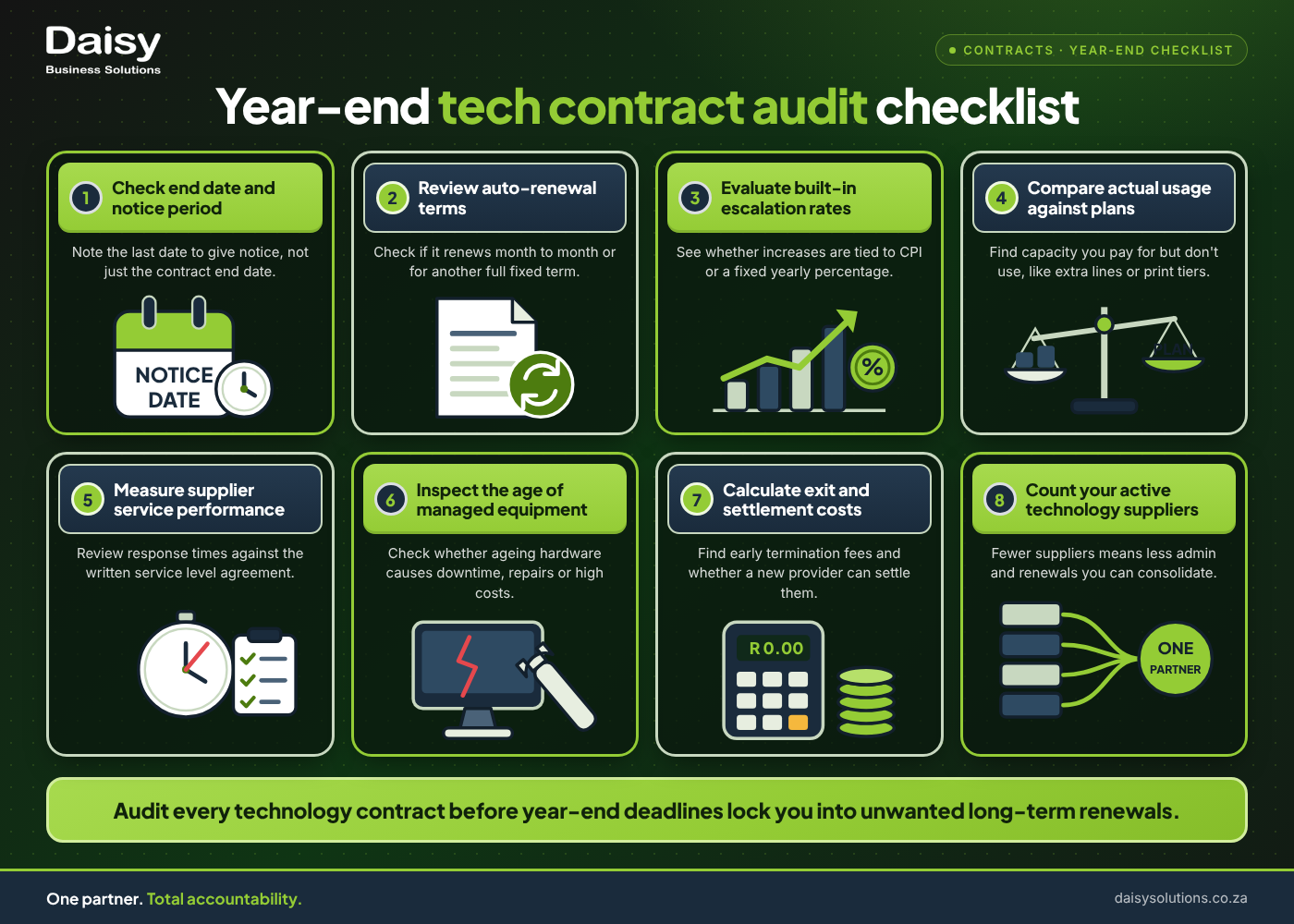
Look over all your technology agreements together, in one place: print, IT support, connectivity, telecoms, security and any equipment rentals. Pay attention to the following:
- 1End date and notice period: Write down the last day you can give notice, not just the end date. Put it in the calendar with a reminder 30 days earlier.
- 2Renewal clause: Does the contract auto-renew? For how long? Is it month to month, or another full fixed term?
- 3Escalation rate: Is it linked to CPI, or a fixed percentage? Fixed rates set in a high-inflation year can now be costing you more than they should.
- 4What you actually use: Compare the plan with reality. Are you paying for 12 telephone lines when 7 are used, or a print volume tier you never reach?
- 5Service performance: Look at your business's service calls over the past 12 months. How fast did the supplier respond, and did it match the SLA? If there's no SLA in writing, that's your answer.
- 6Equipment age: You're spending more on a printer or server near the end of its life (in downtime and repairs) than you save in monthly payments. Check if your contract includes upgrades when the term ends.
- 7Cancellation and settlement costs: Find out what it costs to exit early, and whether a new provider can settle the balance as part of a switch.
- 8Supplier count: The average business manages 4.3 separate technology suppliers, each with its own contract, invoice and end date. Count your suppliers.
That last point matters more than you may realise. Each separate contract is another notice period to track, another escalation clause and another call centre when something breaks. Consolidating at renewal is often the easiest way to cut both cost and admin.
Print is a good example. Daisy's print audits regularly find 25% to 40% in hidden waste. One client cut monthly print spend from R28,000 to R16,500, a saving of R138,000 a year, simply by right-sizing the fleet when the contract came up. If print is on your list, our guide to managed print services covers what a modern print contract should measure.
How financing removes the timing problem entirely
This is where most reviews stall. You find the problem before the year is up, but the fix needs budget, and the budget isn't approved until March. So, the old contract rolls over, and the gap stays open for another year.
It doesn't have to work that way. With in-house finance, the cost of new technology is spread into a monthly payment that starts when the equipment goes in, not when the next capital budget is signed off.
DaisyFin is in-house, so there's no bank in the middle. Qualifying businesses can start with R0 deposit, and credit decisions are made in-house. It covers IT infrastructure, managed print, connectivity equipment, telecoms hardware, CCTV and access control, and solar and backup power.
Here's how that looks in practice. A Gauteng electronics manufacturer needed IT and print infrastructure to the value of R420,000. Instead of waiting for a capital approval cycle, it financed both at R14,200 a month over 36 months. Everything was installed within two weeks, and no working capital was drawn.
Rental structures like this are usually treated as an operating expense rather than a capital purchase, which can help with both cash flow and tax. Confirm how it applies to your business with your accountant.
The bigger point is timing. When cost stops being the blocker, you can make the right decision instead of the convenient one.
Questions to ask before renewing any contract
What should I ask my current supplier before renewing?
Ask for a usage report for the last 12 months, the escalation that will apply next year, the current settlement figure, and whether newer equipment is available at the same or a lower monthly cost. A supplier who wants to keep you will usually have answers ready.
Should I renew with the same provider or switch?
Renew if the service has been good, the pricing is fair against the market, and the equipment is current. Switch if you've had repeated SLA misses, you're paying for capacity you don't use, or you're managing too many suppliers. Either way, get at least one competing proposal so that you know what fair looks like.
Is it worth combining contracts under one provider?
Often, yes. One contract means one renewal date, one invoice and one number to call. The trade-off is that you depend more on a single provider, so check their national footprint and support record first.
What if my contract has already auto-renewed?
Read the renewal clause carefully. Some renew month to month, which you can usually exit on notice. Others renew for a full term, in which case you can ask for the early settlement figure. A new provider may be able to settle it as part of the switch.
How long should a technology contract run?
Most equipment contracts run 36 to 60 months. Shorter terms mean higher monthly costs but more flexibility. Longer terms lower the monthly payment but make built-in upgrades and clear exit terms more important.
December closes fast
If you're reading this in November, there's still time to make considered decisions about your current contracts. Leave it until the second week of December, and there won't be.
Daisy can review all your technology contracts with you, across print, IT, connectivity, telecoms and security, and show you what one contract, one invoice and one SLA would look like. With 56 branches and more than 40 years in South African business technology, the people who service your equipment are close by.
Book a no-obligation audit and get a custom proposal.
Want to solve your Business Finance challenges?
Daisy provides end-to-end business finance solutions tailored for South African businesses. One SLA, one partner.
Daisy Business Solutions
Daisy Business Solutions is a leading South African technology partner, connecting, securing, powering and financing businesses under one SLA across eight divisions. Our team shares practical insights to help SA businesses get more from their technology.