Your Guide to Document Management and Automation
The lifespan of a document is undefined, and its journey across the workplace is, ironically, unwritten. Document management and automation solve this and change how your business handles information: from how it is saved and sorted to who can access it and how efficiently it is stored.
Paperwork no longer looks the same as it did in the early 2000s, when you presented a copy to each team member and stored the original in a filing cabinet. There is no need to bury documents in overstuffed drawers, email inboxes, or shared drives.
What is document management and automation?
Document management and automation refers to systems and processes that handle documents digitally by creating, storing, organising, retrieving, sharing, and eventually archiving or disposing of them. By automating repetitive tasks that once required manual effort, you are simplifying tasks, saving time, and streamlining processes.
The term is a broad one overall, but here is what it means for your business. Let us look at the core capabilities of document management and automation separately to understand their benefits.
Document management
The core capabilities of a document management system usually include:
Storage and organisation
Centralised repositories, often cloud-based, with folder structures, tagging, and metadata so files can be found without difficulty.
Version control
Tracking changes over time, so you always know which version is current, and you can revert to older versions if you need to.
Access control and permissions
Governing who can view, edit, or share specific documents. Document security in the digital age is integral to protecting sensitive business information.
Search and retrieval
Indexing content, sometimes with OCR for scanned files, so documents are searchable by keyword and not just filename.
Compliance and retention
Enforcing rules about how long documents are kept and when they are deleted. This is ideal for legal and regulatory purposes.
Audit trails
Logging who accessed or changed a document, and when.
Document automation
This layer focuses on reducing manual work around documents, such as:
Template-based generation
Auto-populating contracts, invoices, reports, or letters from data sources such as a CRM or spreadsheet.
Workflow automation
Routing documents through approval chains, signatures, or reviews automatically.
E-signatures
Integrating tools to eliminate print-sign-scan cycles.
Data extraction
Using OCR or AI to pull structured data out of unstructured documents, like extracting line items from a scanned invoice.
Triggered actions
When a new document is uploaded, automatically classifying it, notifying the right people, or kicking off a related task.
Digital documents include anything from spreadsheets of financial records to training documentation, scanned receipts and signage, and statements, forms, and invoices in PDF. Images, videos, and audio files also count as digital documents, and all these assets behave differently. Document management solutions can benefit your business, and we are here to help you make the transition with ease.
Why organisations use it
- Less time searching: for or recreating documents
- Less manual data entry: and fewer errors
- Faster approvals: and shorter turnaround cycles
- Better compliance: and reduced legal and regulatory risk
- Clear accountability: through a complete audit trail
Document management and automation for South African businesses is about more than simply going paperless. It is about creating a more secure and controlled document environment. At Daisy Business Solutions, we help with a complete approach that includes print management software and electronic document management. We also offer businesses affordable, flexible printer rentals.
How do you know you have outgrown your current system?
Despite the many evident benefits of document management, most businesses get pushed into this investment after a tipping point. So what should you look out for in your own business to ensure you are making the switch before the cost of inaction outweighs the cost of change? Here are the warning signs.
- 01
You are searching more than you are working
If your team regularly spends ten or fifteen minutes hunting for a file across email, shared drives, and someone's desktop, that is not a once-off inconvenience. It takes a toll on productivity that compounds across every employee, every week.
- 02
Version confusion is a running joke
Final_v2_ACTUAL_final.docx is funny until it is the version a client signs, and then it still turns out to be the wrong one. If your team cannot confidently say which document is current without checking with a colleague first, you have a version control problem, not a people problem.
- 03
Approvals stall in inboxes
From contracts that sit in someone's email for days to invoices waiting on a sign-off that never got flagged as urgent, manual approval chains break down the moment your team gets busy. And they are always busy.
- 04
Compliance feels like guesswork
If you cannot say with confidence how long you are required to keep a specific record, or who accessed a sensitive document last, you are relying on fragmented recollections rather than a system. That is a real liability in regulated industries.
- 05
You are paying for storage you do not need
Duplicate files, outdated drafts, and files nobody has touched in years still take up space, whether that is physical filing cabinets or cloud storage you are paying for. The cost adds up fast.
- 06
New hires take too long to get productive
If onboarding someone means walking them through "well, this lives here, but sometimes it is also here", your document structure is slowing them down before they have started real work.
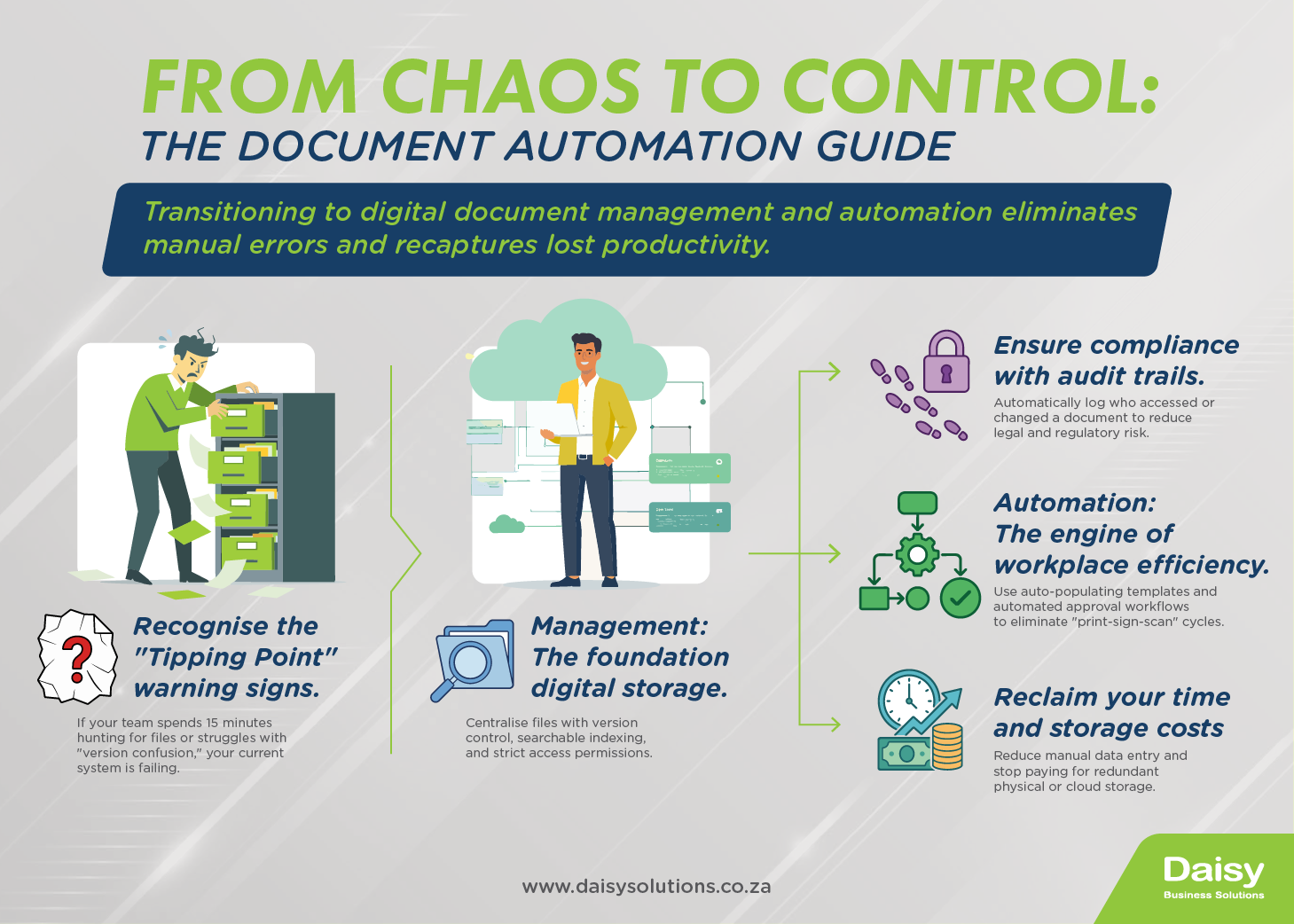
These are the kinds of problems that build up over time rather than showing up as an isolated crisis. If the idea of automation makes you breathe a sigh of relief, you have probably been ready to make the change for a while. Learn more about process automation and workflows and our EDMS solutions, built for SMEs and large, multi-site operations alike.
From chaos to control
The good news is that Daisy Business Solutions specialises in exactly this. If you are looking for one technology partner to handle your business automation and technology, as well as important upgrades, talk to us.
One discovery session. Bring the process costing you the most time, and we will show you what it would take to fix it.
Want to solve your Software challenges?
Daisy provides end-to-end software solutions tailored for South African businesses. One SLA, one partner.

Daisy Business Solutions
Daisy Business Solutions is a leading South African technology partner - connecting, securing, powering and financing businesses under one SLA across eight divisions. Our editorial team shares practical insights to help SA businesses get more from their technology.