What SA Businesses Need to Know About Ransomware Risk
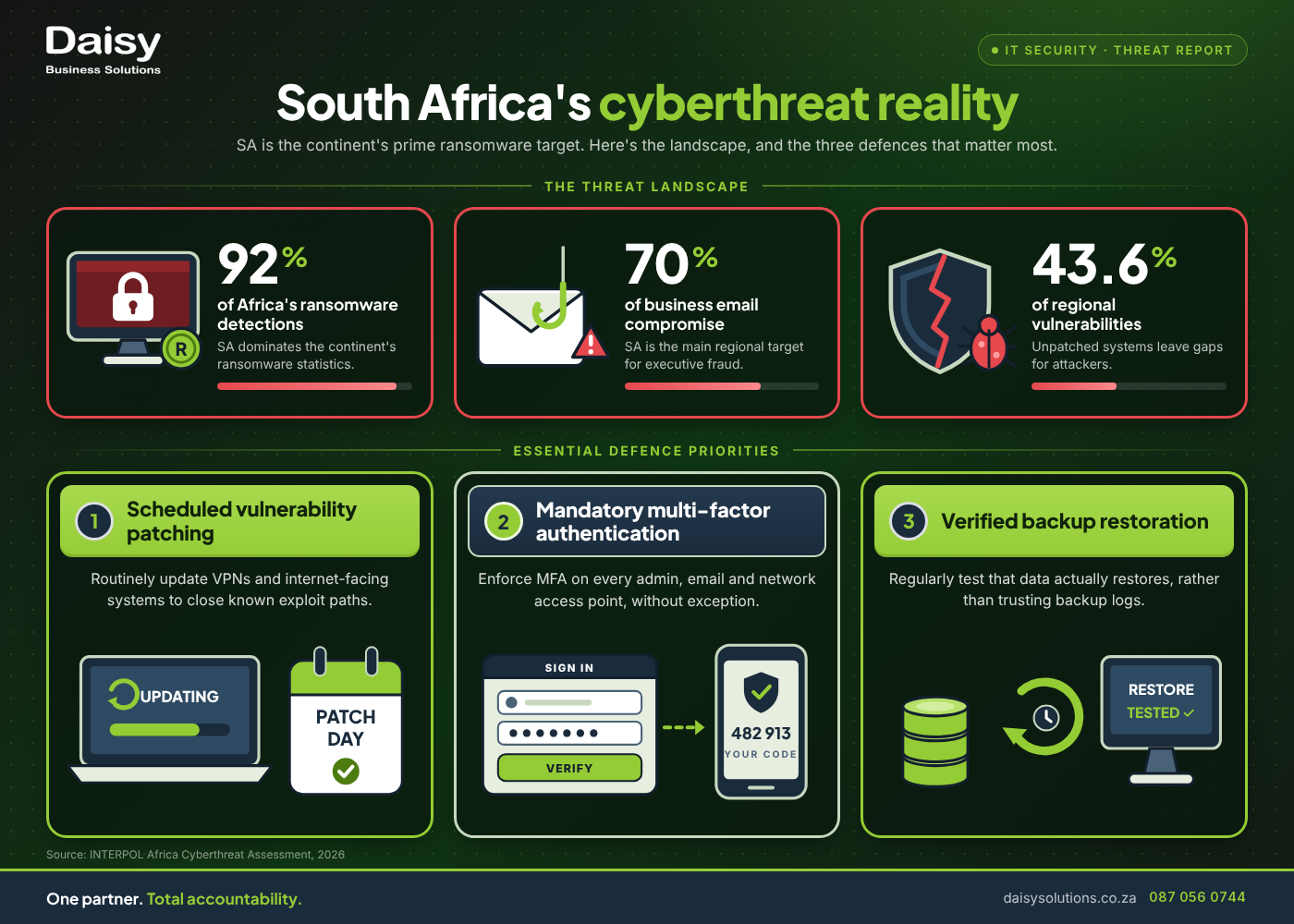
South Africa accounts for 92% of all ransomware detections recorded across Africa, according to INTERPOL's 2026 African Cyberthreat Assessment. This is more than a marginal difference; it can stop business owners in their tracks. That percentage is worth sitting with. It is not a distant, global-headlines risk. It's a concentrated problem that most South African businesses are still underprepared for.
Let's take a closer look at what the INTERPOL report found, why South African businesses specifically are being targeted, and what kind of difference a properly managed security setup makes. Our Daisy IT team also shares a short checklist that you can run against your own business to see where you stand.
The scale of the problem: what the INTERPOL 2026 report found
INTERPOL's African Cyberthreat Assessment, drawing on detection data from TrendAI, found that South Africa dominates the continent's ransomware statistics. The report also places South Africa at the centre of several other categories:
| Threat | South Africa's share of Africa's detections |
|---|---|
| Ransomware | 92% |
| Business email compromise (BEC) | About 70% |
| Exploitable vulnerabilities | About 43.6% |
| Phishing | About 40% |
The report also recorded 213,523 DDoS attacks targeting the region, with bandwidth peaks reaching 312 Gbps. This indicates attacks designed to knock systems offline instead of extracting a ransom, and forms part of the same broader pressure on South African infrastructure.
This problem goes beyond the private sector. The report mentions a ransomware attack on the South African Weather Service that disrupted meteorological data, leading to knock-on delays to aviation routing and maritime navigation. This shows that a successful attack doesn't stay contained to the organisation it hits.
Why South African businesses are being targeted
South Africa is seen as a disproportionately attractive target for three overarching reasons. The INTERPOL report highlights them as rapid digital adoption, advanced subsea cable connectivity, and a deeply integrated financial sector. The country has plenty of valuable, well-connected and financially active targets, which is exactly what attracts transnational ransomware syndicates, executive fraud networks and infrastructure-focused attackers.
Weak points that enable cyberattacks include high numbers of exploitable, unpatched vulnerabilities and prior data breaches whose stolen credentials circulate on dark web markets. The report also points to real gaps in public-sector capacity, like real-time threat intelligence sharing and cryptocurrency tracing. This slows down the broader response time and makes South Africa a comparatively low-risk environment for attackers.
If any of this sounds familiar, Daisy can help with Managed IT services, whether you're protecting your VoIP before a cybersecurity disaster or consolidating your tech stack so that you never have to chase multiple vendors again.
On the financial side, the same INTERPOL report notes that BEC networks are actively targeting foreign enterprises operating in South Africa. Synthetic identities are used to bypass KYC checks and open bank accounts and credit facilities fraudulently. Understanding the cybersecurity blind spots that hurt businesses later helps organisations stay protected.
What a managed security setup helps to prevent
Most ransomware doesn't succeed because an attacker is unusually sophisticated. It succeeds because a vulnerability remains unpatched for months, a login has no second factor, or a backup programme was never tested. If nobody is watching the network closely enough to catch these early signs before encryption, you're an easier target than you may have realised.
A good managed security setup closes these gaps as a standing routine rather than a once-off project:
Patching and vulnerability management
The unpatched VPNs and known exploitable gaps the INTERPOL report flags as South Africa's specific weak point get closed on a schedule.
Monitoring that catches early warning signs
Ransomware rarely detonates the moment a network is breached. There is usually a window of unusual activity first, which is only noticed if someone is watching.
Tested backups
Not just backups that run, but backups someone has confirmed can be restored, so that a ransom demand isn't the only way to get your data back.
Multi-factor authentication and access control
Closing off the credential-stuffing and phishing routes that stolen logins from past breaches make possible.
One team accountable for everything
Rather than physical security, network security and backups being three different people's problem, with gaps opening up in the handoffs between them.
A simple risk checklist for a 50-person business
- 1Are all internet-facing systems (VPNs especially) on a documented patching schedule?
- 2Is multi-factor authentication enforced on email, VPN and admin accounts, not just as an available option, but as a requirement?
- 3Have your backups been test-restored in the last three months? Simply confirming that they are "running" is not enough.
- 4Does anyone get an alert for unusual login activity or data movement outside business hours?
- 5Does your company have a written incident response plan in place? And does more than one person know where to find it?
- 6Have staff had phishing-awareness training in the last twelve months?
- 7If you were the target of a cyberattack tonight, do you know how long full restoration would take?
If more than one or two of these are a "no" or "not sure", then your company fits the gap an attacker is counting on. Take control now, starting with Navigating Workplace Cybersecurity: A Business Guide by our team of Daisy experts.
Don't let South Africa topping Africa's ransomware detections be your reason to panic. Rather, treat it as an opportunity to shift gears and take control of your business.
If you'd rather have someone assess where your own gaps are than work through the list alone, Daisy's assessment covers these areas in full.
Want to solve your IT Managed Services challenges?
Daisy provides end-to-end it managed services solutions tailored for South African businesses. One SLA, one partner.
Dylan Gordon
Dylan Gordon writes on IT Managed Services for Daisy Business Solutions, the South African technology partner that connects, secures, powers and finances businesses under one SLA across eight divisions.