Enterprise Security Solutions: What Belongs in the Stack
When most businesses describe their security, they focus on cameras and the infrastructure that meets the eye. There is real uncertainty around what happens when someone with a valid access card walks into the server room after hours or prints the payroll file and leaves it sitting in the tray.
This gap is what this guide by Daisy Business Solutions is about. Enterprise security is much more than just one product you buy from one catalogue. It's a stack, with several layers that each cover something the others can't, and that only really work when they talk to each other. Most South African businesses we assess are missing at least one layer.
What are enterprise security solutions? Enterprise security solutions are the combined physical, digital and document controls in place to protect a business's people, premises and information. A modern stack usually includes access control, CCTV with video analytics, intrusion detection, network and cyber security, and print and document security. These are usually managed under one support arrangement.
What "enterprise security" covers for businesses
For years, security was split three ways. Facilities oversaw the doors and cameras, IT managed the network, and office printers were not even factored in. Those handover points are where incidents now happen.
The numbers explain why. Robberies at non-residential premises fell 22% year on year between January and March 2026 (SAPS Q4 2025/26 statistics), but SAPS still recorded 10,943 burglaries at non-residential premises in that quarter, more than 120 a day. Online, South Africa accounts for 92% of Africa's ransomware detections, as outlined in INTERPOL's 2026 African Cyberthreat Assessment (see our ransomware risk guide).
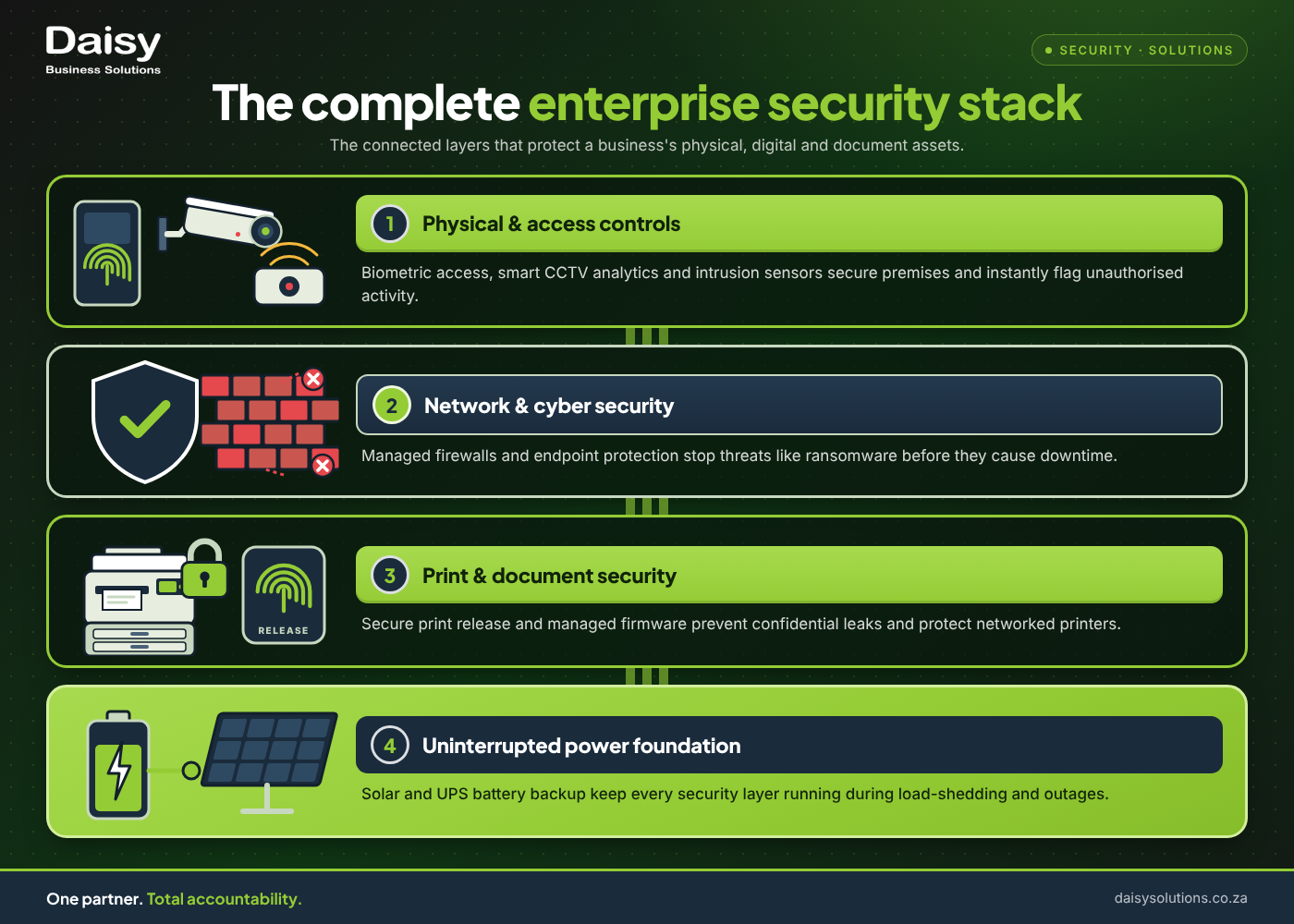
A business that only defends one of those fronts is only half prepared. Here's how the full stack breaks down:
- 1Access control: Decides who gets in, as well as where and when. Without it, anyone with a key or a borrowed card can enter and exit freely.
- 2CCTV and video analytics: Watches the site and flags incidents. Without it, you only find out the next morning, from footage.
- 3Intrusion detection: Detects forced entry and after-hours movement. Without it, a break-in goes unnoticed until office hours commence and staff arrive.
- 4Network and cyber security: Protects devices, data and the network. Without it, data can be stolen without anyone ever needing to step onto your premises.
- 5Print and document security: Controls who prints, scans and collects what. Without it, sensitive pages sit in trays and printers become open network endpoints.
Underneath this stack lies a foundation most plans forget: reliable power. Can your business security stand strong during an unforeseen outage?
How access control, CCTV and alarms work together
Biometric security features, such as fingerprint scanning, facial recognition and thermal detection, all make credentials much harder to copy or duplicate. Dedicated zones matter too, since the warehouse team doesn't require finance office access, and contractors don't usually work late hours. As a bonus, access data is useful when it comes to time and attendance and payroll, as it holds team members accountable.
CCTV: from recording to recognising
In the past, the role of CCTV was to record everything, only for it to be reviewed after something went wrong. Most businesses don't have the time to watch eight hours of footage from twelve cameras.
As Sashveer Dheepnarain, Daisy's Security Technical Manager, puts it: "Systems should mitigate loss and improve profitability, not just record footage that takes time to review."
That's why event-based video analytics matter more than camera resolution. A well-configured system flags unusual movement, out-of-hours access, or till activity that doesn't match a normal transaction, and pushes the alert as it happens. Thermal cameras extend visibility to dark perimeters and large yards, where standard cameras struggle to differentiate between a person and a shadow.
Intrusion detection: the after-hours layer
Sensors on doors, windows and open spaces cover the hours when nobody is on-site. These are the hours that most businesses get targeted. Tuning matters as much as hardware, since a system that "cries wolf" too often eventually gets ignored or quietly switched off. This is why Daisy Business Solutions ensures security solutions that work from day one.
Why integration matters more than any single device
Imagine it is 9 pm on a Friday. Someone forces their way in through the side door of your business's warehouse.
In an integrated stack that works as it should, the intrusion sensor triggers, the nearest camera flags the event and sends you a clip, and the access log confirms that no valid card was used. Within a minute, you know what you're dealing with, and you can take action swiftly and confidently.
In a disconnected security setup, that's three systems from three separate suppliers, each with their own logins. The footage only gets checked on Monday.
Power belongs in the plan too. Daisy installations tie into solar or UPS backup, and remote sites can run cameras on solar with an LTE link.
Where document and print security fit into the stack
A modern multifunction printer is a networked computer with printing functionality (learn more on this in our post on AI and automation in print). It's the layer businesses skip the most, and it has risks that are easily overlooked. The device itself may have old firmware that makes your network easy to access, or you might be printing sensitive information that stands on the output tray for anyone to see. Under POPIA, businesses must take proper measures to protect personal information, meaning that a stack of uncollected HR printouts is a compliance and security issue.
The fixes are practical:
- Secure print release (Follow-Me printing): jobs only print when the user authenticates at the device with a PIN or card, and the same card can open your doors.
- Print management software: PaperCut, uniFLOW or Kofax add authentication, usage reports and an audit trail of who printed what.
- Secure cloud printing for hybrid staff, with access controls in place.
- Printers managed as network devices, with firmware updates and the same firewall policies as your other endpoints.
Read more about this in Hybrid, Not Paperless.
The layer nobody sees until it fails: network and cyber security
Locks don't help when a phishing email comes in late on a weeknight. A managed firewall, endpoint protection and active monitoring stop a ransomware infection from becoming a week of downtime, and response time is what separates a service from a box on the wall. Daisy's managed IT SLA commits to a 30-minute remote response.
What to look for in a provider before you commit
The average business manages 4.3 separate technology suppliers. Security is where that hurts most, because the gaps between suppliers are the gaps attackers take full advantage of. Before you sign, ask:
- 1Can they design across every layer? If your security installer can't talk to your IT provider, you're paying for two half-stacks.
- 2Are they PSIRA-registered? Firms that install security equipment in South Africa must be. Ask for the number.
- 3Who services it, and how far away are they? A local branch beats a call centre in another province.
- 4What does the SLA say? Get response times in writing, ideally under one SLA for everything.
- 5What happens when the power goes off? If the cameras go off too, keep looking.
- 6Are they vendor-independent? Accredited with several brands means they specify what suits your site, not what's in stock.
- 7How will you pay for it? Waiting for next year's budget leaves the gap open. DaisyFin offers R0 deposit options and approval within 48 business hours.
Frequently asked questions
What is included in an enterprise security solution?
A complete solution covers access control, CCTV with video analytics, intrusion detection, network and cyber security, and print and document security. Ideally, these are integrated and supported under one agreement.
What's the difference between enterprise and commercial security?
Commercial security usually means physical protection of premises. Enterprise security takes in the whole business, including data, networks and documents, across one site or many. For the physical side, read why prevention beats reaction.
Does a smaller business need a full security stack?
It needs every layer, but not every layer at enterprise scale. A 20-person office might run one access controller, four cameras and secure print release on a single device. The principle doesn't change: no missing layers.
Find your missing layer before December does
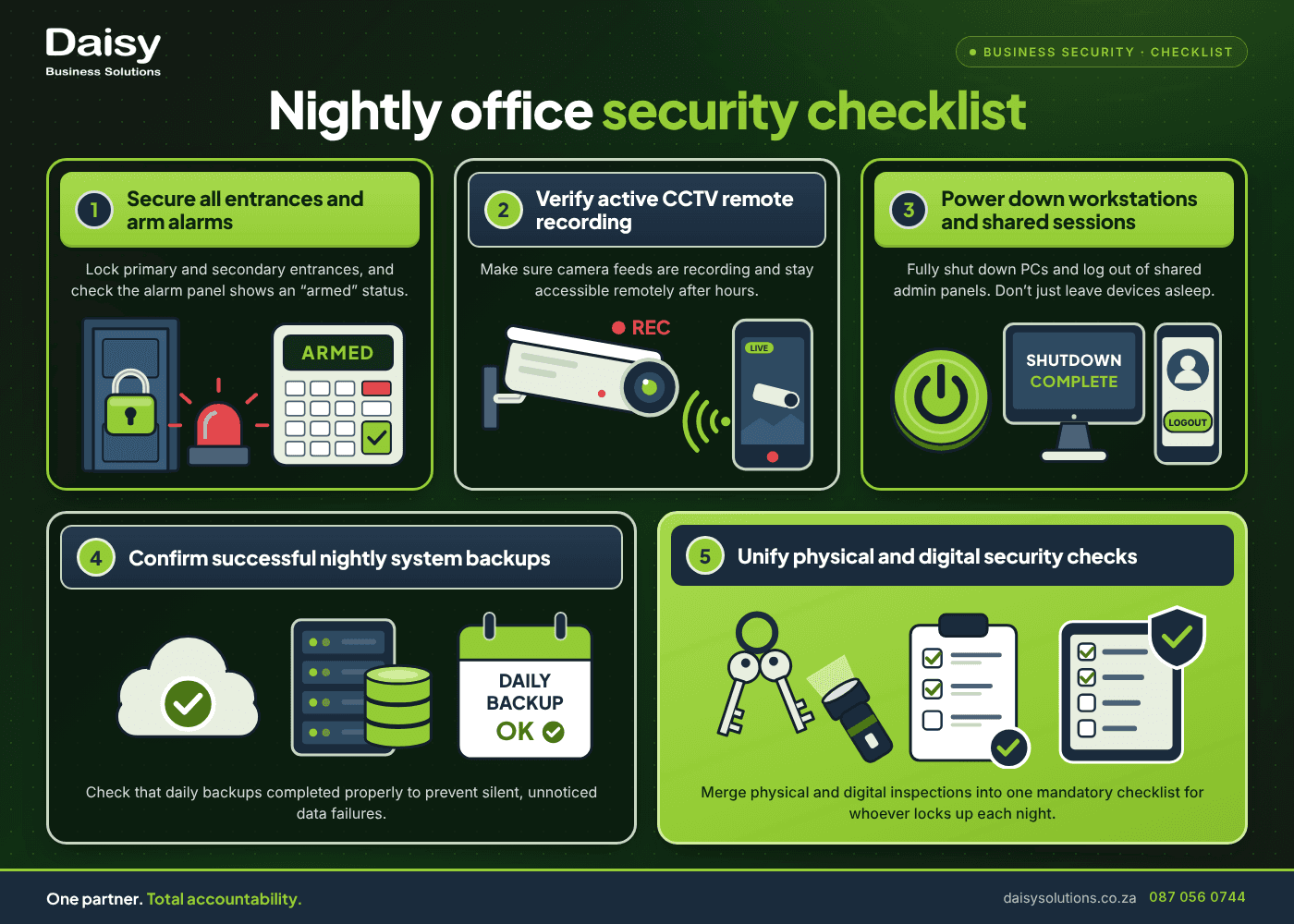
Many offices will stand empty for two or three weeks over the December shutdown, which makes it the hardest test your security stack faces all year. If you're preparing for it, start with our office shutdown checklist.
Then let us look at the full picture. Daisy has served South African businesses for more than 40 years, with 56 branches whose teams service what they sell, and one contract and one invoice across security, IT and print.
You'll get a no-obligation audit and a custom proposal.
Want to solve your Physical Security challenges?
Daisy provides end-to-end physical security solutions tailored for South African businesses. One SLA, one partner.

Sashveer Dheepnarain
Sashveer Dheepnarain writes on Physical Security for Daisy Business Solutions, the South African technology partner that connects, secures, powers and finances businesses under one SLA across eight divisions.